What Is the Balance of Trade and Why Bloggers Should Care About It
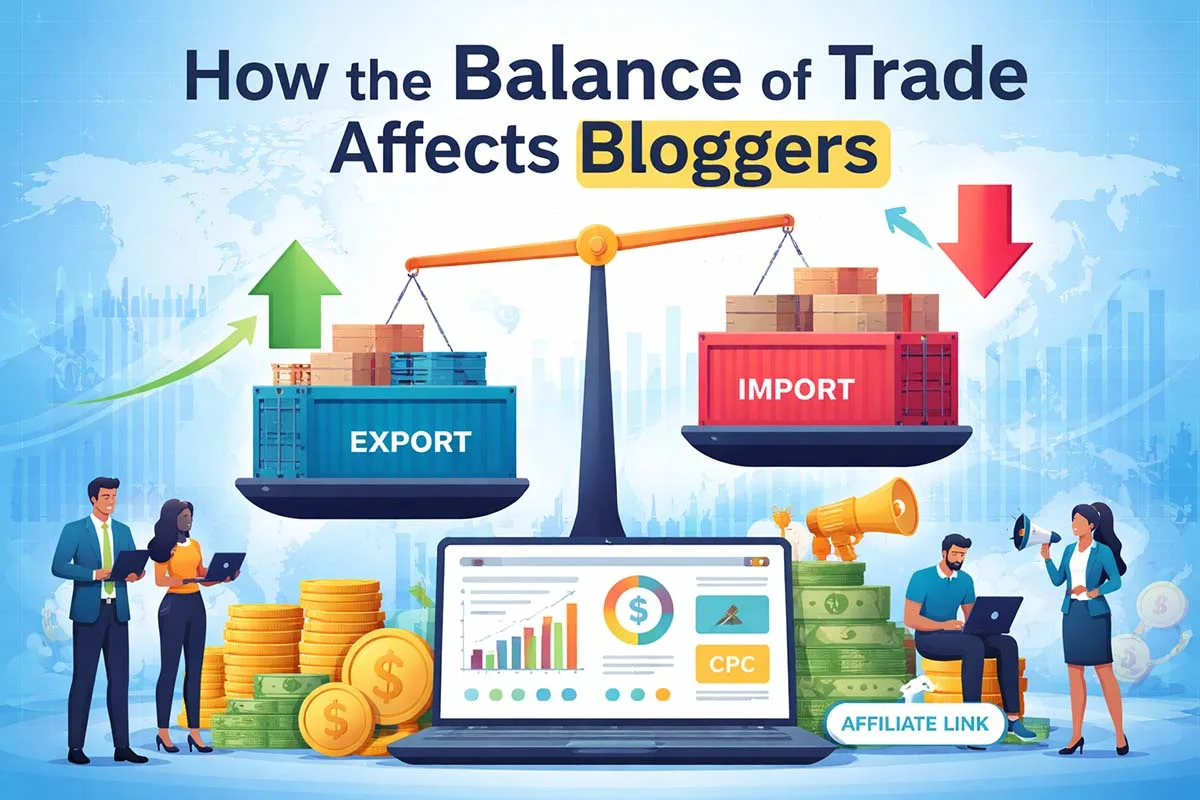
At first glance, the balance of trade sounds like a topic you would hear from economists and policymakers only. It appears in government reports, trade negotiations, and various macroeconomic headlines. It is not something you would see on blogs, ads, or affiliate links. However, for anyone running an online business, the balance of trade quietly influences the economic environment that determines advertising budgets, consumer spending, and digital revenue potential. In this guide, we will discuss and explain what the balance of trade is and why bloggers should care.
Understanding the balance of trade in simple terms
Understanding the meaning of balance of trade helps explain why ad rates rise in some periods and fall in others, why affiliate conversions fluctuate by country, and why global traffic monetization is not even. For bloggers, creators, and digital marketers, this is not abstract theory; it is part of the financial ecosystem that influences the internet economy.
The balance of trade is the difference between what a country exports and what it imports. When exports exceed imports, it is called a trade surplus, and when imports exceed exports, it is a trade deficit.
When a country sells more goods and services to other countries than it buys, then it runs a surplus. If it buys more than it sells, it runs a deficit. This balance is a very critical metric as it affects currency strength, economic growth, corporate profits, government revenue, and consumer purchasing power.
Why the balance of trade influences the digital economy
A country’s trade balance position directly affects how much money circulates in the domestic economy and how confident businesses feel about spending it. A trade surplus usually signals strong exporting industries, competitive global businesses, higher corporate profits, and more capital flowing into the economy. The trade deficit, on the other hand, signals heavy reliance on imports, currency pressure, higher business costs, and lower profit margins. Dependence on imports is never good for the economy as it makes businesses vulnerable to foreign currency fluctuations.
When businesses are financially strong, they advertise more, and when profit margins are tight, marketing budgets are often the first to be reduced. For bloggers, this matters a lot because advertising and affiliate revenue are dependent on other companies’ willingness to spend on marketing and ads.
Why the balance of trade matters online
Most digital advertising markets like Google Ads, Meta, Amazon, and affiliate marketing platforms are priced in dominant currencies like the dollar and euro. Currency strength affects how much advertisers can afford to pay, the real value of ad payouts in local currency, and the purchasing power of your audience. A weakening local currency makes imported goods more expensive, reducing consumer spending and lowering conversion rates on affiliate links and offers. Here is where the trade balance comes into the equation:
- Countries with strong exports usually have stronger currencies.
- Countries with trade deficits face currency depreciation more often.
This is why a seemingly unimportant economic metric, such as trade balance, has such a tremendous impact on the digital economy.
Advertising rates and eCPMs
Advertising rates are related to other economic factors. They reflect how profitable advertisers expect customers to be. When trade conditions are strong, exporters earn more profits, domestic companies expand faster, marketing budgets grow, and competition for ads increases. This drives higher CPMs and eCPMs, especially in export-heavy countries like the USA, Germany, Japan, and South Korea. When trade conditions are weaker, input costs rise, profit margins shrink, businesses reduce spending, and advertising budgets are tightened. Bloggers often feel these effects as falling display ad rates, lower RPMs, and reduced sponsorship offers.
Affiliate revenue and consumer purchasing power
Affiliate marketing depends heavily on consumers’ ability and willingness to spend. When imports dominate and cause the currency to weaken, imported products usually cost more, shipping fees rise, and consumers are hesitant to make purchases. This, in turn, lowers conversion rates, average order values, and commissions.
Trade surpluses in export-driven economies tend to cause stronger wages in competitive sectors, higher income across digital platforms, and more confident consumers. Affiliate offers in tech, travel, software, and finance often perform much better in these countries. This is why the same affiliate link can perform very differently depending on the visitor’s country of origin. As a result, digital marketers and bloggers try to target audiences with stronger currency and purchasing power to ensure consistently growing income from their ads.
For more insightful articles, please visit Bloghart.