DePIN and the GPU Compute Market: How GPUnex Bridges Decentralized Infrastructure and Enterprise Compliance
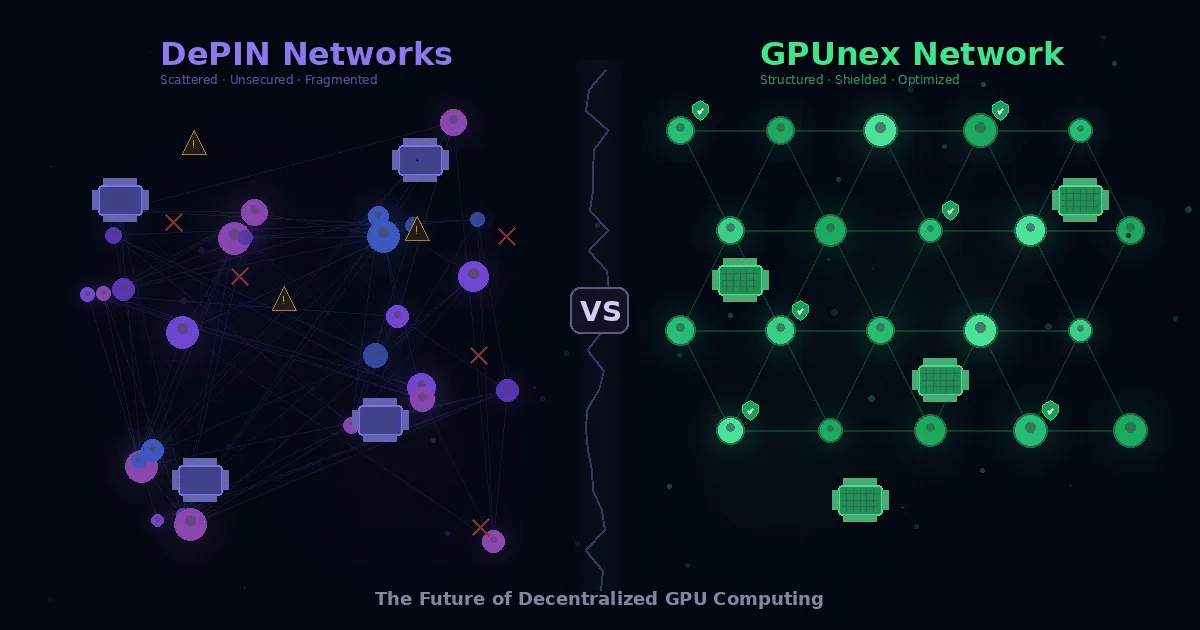
Decentralized Physical Infrastructure Networks — DePIN — have become one of the fastest-growing segments in the crypto economy. The sector’s combined market capitalization grew from roughly $5.2 billion to $19.2 billion between September 2024 and September 2025, a 265% increase tracked by CoinMarketCap and Messari. Onchain revenue reached an estimated $72 million in fiscal year 2025. Nearly 250 projects are now tracked across CoinGecko’s DePIN category, with a total addressable market that Messari estimates at $2.2 trillion.
These are not trivial numbers. But they come with a caveat that matters for anyone evaluating DePIN as serious infrastructure: enterprise adoption remains limited. The gap between DePIN’s promise and its production readiness is real — and it is creating space for alternative models.
One of those alternatives is GPUnex, an EU-based GPU compute marketplace that shares DePIN’s core idea of aggregating distributed infrastructure but approaches it with a fundamentally different architecture.
The DePIN Market: Real Revenue, Real Problems
DePIN uses blockchain-based incentives to coordinate the deployment and operation of physical infrastructure — computing power, storage, wireless connectivity, geospatial data. Contributors earn cryptocurrency tokens for providing resources, and the network self-organizes without a central operator.
GPU and AI compute has become the dominant DePIN category, representing 48% of the sector by market capitalization. The leading projects have moved beyond token speculation into actual revenue generation:
- Aethir reported $166 million in annualized recurring revenue in Q3 2025, pricing GPU compute at roughly 70% below AWS rates
- Render Network reached a $770 million market cap with over 22 million frames rendered in 2025, and has pivoted from graphics rendering toward general-purpose AI workloads
- Akash Network generated $15 million in revenue through its Starcluster approach, combining managed data centers with a decentralized marketplace
- io.net offers distributed GPU cluster deployment in under two minutes, aggregating capacity from data centers, crypto miners, and other networks
- Helium — operating in decentralized wireless rather than compute — reached 379,000 active hotspots and $24 million in 2025 revenue, demonstrating DePIN viability beyond GPU infrastructure
These are revenue-generating businesses with measurable output, not speculative tokens riding a narrative cycle.
Where DePIN Falls Short for Enterprise
The revenue is real. But for enterprise customers — particularly those in regulated industries — DePIN’s structural limitations remain significant.
No Formal SLAs
Most DePIN networks offer no uptime guarantees. Hardware quality varies by contributor, and there is no mechanism to enforce consistent performance across a distributed, permissionless network. For production AI workloads that cannot tolerate interruptions, this is a fundamental limitation.
Tokenomics Volatility
Provider incentives in DePIN are denominated in native tokens. When token prices drop, provider motivation drops with them — and capacity can exit the network precisely when it is needed most. This creates a reliability model that is inversely correlated with market stress, which is the opposite of what enterprise customers need.
Compliance Gaps
DePIN networks generally lack GDPR compliance, escrow protection, or formal transaction security. For organizations operating under European data protection law or the EU AI Act, this effectively disqualifies most DePIN platforms from consideration.
Quality Variance
Contributor hardware ranges from consumer GPUs to enterprise-grade accelerators. Maintaining consistent benchmark performance, network throughput, and storage reliability across thousands of unverified nodes is an unsolved challenge, as documented by Resonance Security and Messari’s “Challenges in DePIN 2025” report.
DePIN has evolved from speculation to real infrastructure. But the enterprise gap remains significant.
GPUnex: A Different Model
GPUnex is not a DePIN project. It does not use token-based incentives, it does not operate a permissionless network, and it does not rely on decentralized governance. It is a managed marketplace with a centralized operator.
But it addresses the same fundamental problem: making distributed GPU infrastructure accessible to AI teams at prices well below hyperscaler rates.
The platform operates 2,400+ active NVIDIA GPUs — H100, A100, L40S, and L4 accelerators — across 150+ verified data centers operated by Equinix, Digital Realty, OVHcloud, Hetzner, CyrusOne, QTS Realty Trust, CoreSite, and Switch. It offers a 99.9% uptime SLA with per-second billing. H100s on the platform rent for $1.49–$2.50 per hour, compared to $3.00–$6.98 on AWS, Azure, and Google Cloud — a 3–6x cost difference.
Where GPUnex intersects with DePIN is in its settlement infrastructure. All platform transactions settle in USDC on the Solana blockchain, with sub-5-second finality and network fees of approximately $0.001. This is the same blockchain infrastructure that many DePIN projects use — but applied within a compliance framework that includes GDPR adherence, EU jurisdiction, and escrow-protected transactions.
GPUnex also offers GPU revenue packages ranging from $59 to $67,150, allowing participants to fund GPU infrastructure deployments and earn daily returns from enterprise rental operations. Details are available on the platform’s packages page.
The framing is deliberate: GPUnex borrows DePIN’s infrastructure aggregation concept but wraps it in enterprise compliance.
The Trade-Off
Neither model is categorically superior. The trade-off is structural.
DePIN offers permissionless participation, potentially larger network scale, and token-based governance. Vast.ai, the largest decentralized GPU marketplace, lists over 17,000 GPUs — roughly 7x GPUnex’s current fleet. Permissionless networks can grow faster because anyone can contribute hardware without gatekeeping.
GPUnex offers a formal 99.9% SLA, regulatory compliance under EU law, escrow-protected transactions, and predictable settlement in a non-volatile stablecoin. For production workloads in regulated industries, these are not optional features — they are requirements.
Whether GPUnex’s compliance-first model can scale to compete with DePIN’s network effects is an open question. Whether DePIN can close its enterprise readiness gap fast enough to capture production workloads is equally uncertain.
The market may ultimately need both — permissionless networks for experimentation and budget-constrained research, and compliant platforms for production workloads where reliability and regulatory adherence are non-negotiable.
Market Outlook
The underlying demand driving both models is unambiguous. AI compute requirements are growing 4–5x annually, according to Deloitte’s TMT Predictions 2026. NVIDIA’s GPU shortage is expected to persist through 2027 and beyond, per CNBC. Goldman Sachs estimates AI infrastructure spending could top $500 billion in 2026. And venture capital continues to flow into DePIN — approximately $1 billion in 2025 alone — despite public token market weakness.
Whether the future of GPU infrastructure looks more like DePIN or more like GPUnex — or some hybrid of both — depends on which model can solve the enterprise readiness problem first. The demand is there. The question is which architecture earns the trust to serve it.
For more insightful articles, please visit Bloghart.