7 Critical Thinking Exercises That Actually Work
You made a bad call at work last week. You know you did. The signs were there, but you missed them. Now you’re dealing with the mess.
Most advice about improving your thinking skills sounds great. Read more. Question everything. Think deeper. But nobody tells you how to actually do it. You’re left with vague tips that don’t translate to real life.
These seven exercises are different. They come from cognitive research and workplace testing. Companies like Toyota and Harvard use them. You don’t need any specialized equipment to begin today.
Each exercise takes 5 to 30 minutes. You’ll see improvements in your decision-making within weeks. Some people notice changes in days.
The Foundation for Critical Thinking has studied these methods for decades. They work because they target specific thinking patterns. You’re not just reading theory. You’re building new mental habits.
Pick one exercise. Try it tomorrow. Your next decision will be sharper.
Why These Exercises Work
Most critical thinking tips fail because they’re too abstract. These seven exercises succeed because they give you concrete actions. You can measure your progress and see real results.
The World Economic Forum ranks critical thinking as a top-three skill for the modern workforce. Fortune 500 companies train employees using these exact methods. They wouldn’t invest millions if the exercises didn’t deliver.
What sets these exercises apart:
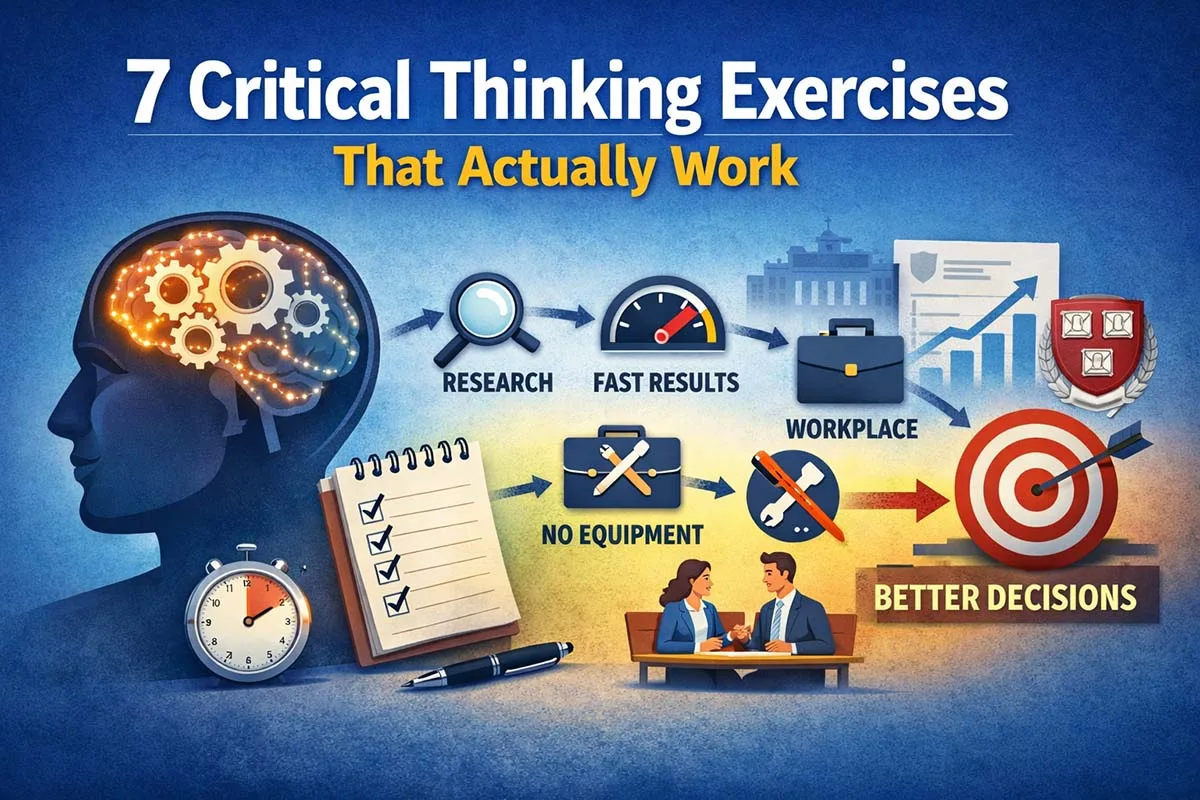
- Research-backed: Each method comes from cognitive science studies, not guesswork
- Fast results: Most people notice sharper thinking within 4 to 6 weeks
- Zero equipment: You need nothing but a pen and paper, sometimes not even that
- Workplace ready: Apply them immediately in meetings, projects, and daily decisions
- Progressive system: Start simple, then advance as your skills improve
You won’t find vague advice here. Every exercise has clear steps. You’ll know exactly what to do and when you’re doing it right.
1. Five Whys Analysis for Root Problems
Toyota created this method in the 1950s to solve manufacturing issues. It’s now used everywhere from hospitals to tech startups. The beauty is in its simplicity.
What it is: You ask “why” five times to dig past surface problems. Each answer leads to a deeper question until you hit the real issue.
How to do it:
- State your problem clearly
- Ask why it happened
- Take that answer and ask why again
- Repeat three more times
- The fifth answer reveals your root cause
Example: Sales dropped last month. Why? Fewer client calls. Why? Team was busy with reports. Why? New reporting system is complicated. Why? No proper training was given. Why? Training budget was cut.
Why it works: Your brain stops at easy answers. Forced repetition pushes past that block.
Time needed: 5 to 10 minutes per problem.
2. Visual Argument Mapping
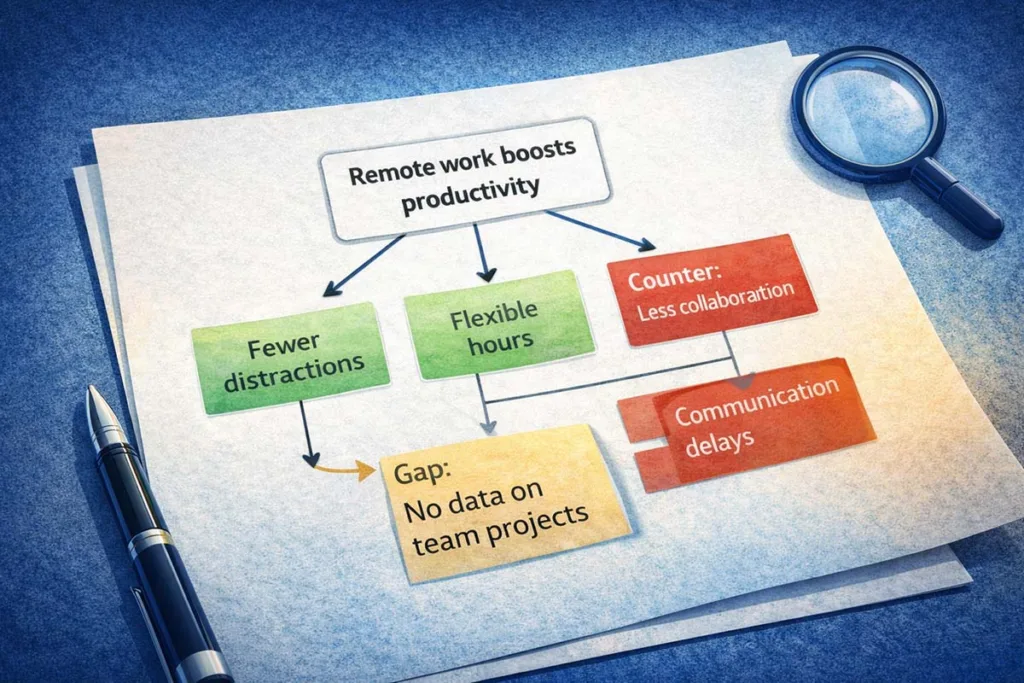
Arguments fall apart when you can’t see the logic holes. Your brain tricks you into thinking weak claims are strong. Mapping exposes those flaws instantly.
What it is: You draw out an argument’s structure on paper. Claims go in boxes. Evidence connects with arrows. Counter-arguments branch off to the side.
How to do it:
- Write the main claim at the top
- Draw boxes for each supporting point below it
- Connect evidence to each point with arrows
- Add opposing views in different colored boxes
- Look for gaps where evidence is missing
Example: Claim: Remote work boosts productivity. Support: Fewer distractions, flexible hours. Counter: Less collaboration, communication delays. Gap: No data on team projects.
Why it works: Visual patterns reveal logical weakness your reading mind misses. You spot bias and assumptions immediately.
Time needed: 10 to 15 minutes per argument.
3. Reverse Brainstorming Technique
Normal brainstorming asks how to solve a problem. Reverse brainstorming flips it. You ask how to make the problem worse. Sounds backwards, but it’s genius.
What it is: You deliberately think of ways to cause or worsen your problem. Then flip each bad idea into a solution.
How to do it:
- Define your problem clearly
- Reverse it: “How could we make this worse?”
- List every terrible idea that comes to mind
- Flip each bad idea into a positive solution
- Evaluate which solutions are practical
Example: Problem: Low team morale. Reverse: How to destroy morale? Ignore achievements, cancel breaks, add pointless meetings. Solutions: Celebrate wins, protect lunch hours, cut unnecessary meetings.
Why it works: Your brain finds it easier to spot problems than solutions. This trick accesses that natural skill.
Time needed: 15 to 20 minutes for most problems.
4. Ladder of Inference Practice

Chris Argyris created this framework to show how we jump to conclusions. You climb seven rungs from observation to action, often in seconds. Most mistakes happen because you skip rungs.
What it is: A seven-step mental process that shows how you move from facts to beliefs to actions. Each rung represents a thinking stage.
How to do it:
- Observe raw data (what actually happened)
- Select specific details you noticed
- Add your personal meaning to those details
- Make assumptions based on that meaning
- Draw conclusions from your assumptions
- Adopt beliefs about the situation
- Take action based on those beliefs
Example: Your boss walks past without saying hello. You select that detail. You assume she’s angry. You conclude you did something wrong. You believe you’re in trouble. You avoid her all day.
Why it works: Awareness of each rung stops automatic judgment. You catch faulty assumptions before they become actions.
Time needed: 10 minutes per situation.
5. Structured Devil’s Advocate Method
You probably think you consider other viewpoints. You don’t. Your brain filters out opposing ideas automatically. This exercise forces you past that filter.
What it is: You deliberately argue against your own position or belief. Find the strongest counter-arguments, not the weakest ones.
How to do it:
- State your current position on any topic
- Set a timer for 10 minutes
- Argue passionately for the opposite view
- Find real evidence supporting that opposing side
- Identify where your original view might be wrong
Example: You believe remote work is better. Now argue why office work is superior: better collaboration, clearer boundaries, faster communication, mentorship opportunities.
Why it works: Defending opposing views builds empathy and reveals blind spots. Your arguments get stronger when you understand the other side.
Time needed: 20 to 30 minutes for complex topics.
6. Daily Socratic Questions
Socrates annoyed people by asking endless questions. He knew something important. Questions reveal truth better than statements ever will.
What it is: You interrogate your own thoughts using six types of probing questions. Each type targets a different thinking weakness.
How to do it:
- Clarification: What exactly do I mean by that?
- Assumptions: What am I taking for granted here?
- Evidence: What proof supports this belief?
- Perspectives: How would others view this differently?
- Implications: If this is true, what else must be true?
- Questions: Why am I asking this question?
Example: Belief: I need a new car. Questions: What problem am I solving? Am I assuming repairs cost more than payments? What evidence do I have? What would a financial advisor say?
Why it works: Deep questioning exposes hidden assumptions and weak reasoning.
Time needed: 5 to 10 minutes daily.
7. Strategic Mind Mapping
Linear notes hide connections between ideas. Your brain thinks in networks, not lists. Mind maps match how your brain actually works.
What it is: You create a visual diagram with your main topic in the center. Related ideas branch out like tree limbs. Connections between branches show relationships.
How to do it:
- Write your central topic in the middle of blank paper
- Draw main branches for major subtopics
- Add smaller branches for details and examples
- Use different colors for different categories
- Draw lines connecting related ideas across branches
Example: Center: Launch new product. Branches: Marketing, Budget, Timeline, Team, Risks. Sub-branches under Marketing: Social media, Email, Events. Connection lines: Link Budget to each branch.
Why it works: Seeing all connections at once reveals patterns and gaps. Your memory improves because visual layouts stick better than text.
Time needed: 15 to 20 minutes per topic.
Making These Exercises Part of Your Routine
Don’t try all seven exercises at once. You’ll get overwhelmed and quit. Pick one that fits your biggest problem right now.
Start small and build:
- Choose one exercise for the first two weeks
- Practice it three times per week minimum
- Add a second exercise only after the first feels natural
- Complex problems need multiple exercises combined
Best practice schedule:
- Daily exercises: Socratic Questions (5 minutes each morning)
- Weekly exercises: Devil’s Advocate, Mind Mapping (once per week)
- As-needed exercises: Five Whys, Argument Mapping, Ladder of Inference (when problems arise)
Track your decisions in a simple notebook. Write the problem, which exercise you used, and the outcome. You’ll spot improvements within four to six weeks.
Practice with a colleague or friend. It makes you think more deeply when you teach someone else. Plus, partner debates make Devil’s Advocate work better.
Track Your Thinking Improvement
Progress feels invisible until you measure it. Keep a simple decision journal. Write down what you decided and why.
Signs you’re improving:
- Decisions take less time but feel more confident
- You catch yourself making assumptions before acting
- Problems get solved faster with fewer mistakes
- You notice patterns others miss
- Overthinking happens less often
Compare your journal entries from week one to week six. The difference will be clear. Better outcomes prove the exercises work.
FAQ Answers
1. What are some critical thinking exercises?
Five Whys Analysis, Argument Mapping, Socratic Questioning, Devil’s Advocate debates, and Mind Mapping are proven exercises. Reverse brainstorming and the Ladder of Inference also build analytical skills. These methods take 5 to 30 minutes and improve decision-making fast.
2. What are the 7 C’s of critical thinking?
The 7 C’s are Curiosity, Confidence, Courage, Commitment, Creativity, Collaboration, and Communication. These traits help you analyze information better. They guide how you approach problems and make decisions. Developing all seven creates well-rounded thinking skills.
3. What are 5 critical thinking techniques?
Five powerful techniques include asking why repeatedly, mapping arguments visually, questioning your assumptions, arguing opposing viewpoints, and connecting ideas through mind maps. Each technique targets different thinking weaknesses. Practice them regularly to see improvement within weeks.
4. What are the 4 C’s of critical thinking?
The 4 C’s stand for Communication, Collaboration, Creativity, and Critical Thinking itself. Some frameworks use Clarity, Credibility, Completeness, and Correctness instead. Both versions focus on evaluating information accurately. The specific C’s vary by educational institution or research organization.
5. More discussions on Tips for increasing critical thinking skills?
Read diverse viewpoints daily to challenge your assumptions. Ask “why” and “how” questions about everything you encounter. Practice solving problems using multiple methods. Debate topics you disagree with to build perspective. Keep a decision journal to track your reasoning patterns and outcomes.
Conclusion
These seven exercises deliver real results because they’re proven methods. Pick the Five Whys if you solve problems daily. Choose Socratic Questions if you make big decisions. Start Devil’s Advocate if you lead teams.
Consistency beats perfection. Practice one exercise three times this week. That’s better than reading about all seven and doing nothing.
Your career depends on how well you think. So does your life. Better decisions compound over time.
Choose one exercise right now. Try it tomorrow morning.
If you found our content helpful don’t forget to share it on your social media: Twitter.